This post contains affiliate links. As an Amazon Associate we earn from qualifying purchases, at no extra cost to you. Read our disclosure.
Safety first: Prices are examples with an as-of date. Always confirm with your own vendors. Please read our editorial guidelines before you start.
Key takeaways
- Count households, not guests, then add a 15 to 20 percent buffer (Joy).
- Joy reports a full suite averaging $518 and invitations alone $226, as of June 22, 2026.
- Square or rigid invitations can add a $0.46 non-machinable surcharge each (Joy).
- An online RSVP replaces the card, envelope and $0.73 return postage (Joy).
- Send save-the-dates 6 to 8 months out and invitations 6 to 8 weeks before the wedding.
In this post22 sections
- Wedding Invitation Ideas: Plan the Suite Before You Print
- 1. Trim the suite to the pieces guests need
- 2. Count households, not guests
- 3. Move the details to a wedding website
- 4. Send the save-the-date digitally, or skip it
- Cheap Wedding Invitation Design Options
- 5. Edit a template and print it yourself or at a print shop
- 6. Order a basic design from an online printer
- 7. Send digital invitations
- 8. Choose a single-card invitation
- 9. Print at home on good cardstock
- Paper, Envelope and Finishing Choices That Cut Cost
- 10. Stick to standard sizes and shapes
- 11. Pick one finishing touch, not four
- 12. Print the addresses or use labels
- Postage, Quantity and Timing Ideas That Save Money
- 13. Replace the mailed RSVP card with an online RSVP
- 14. Weigh a finished sample before buying stamps
- 15. Order once, with the buffer, and proof carefully
- Bonus: Your Invitation Cost Worksheet and Send Timeline
- Put the Savings Into a Real Plan
- FAQ
Joy puts the average full invitation suite at $518 and the invitation alone at $226 (cost guide, updated June 22, 2026). The ideas below cut the parts you control: how many pieces you print, how you print them, the envelope, the stamp and when you order. Prices are examples, not quotes, and they change by printer and by state of the mail rate, so check the total at checkout before you commit.
Wedding Invitation Ideas: Plan the Suite Before You Print
1Trim the suite to the pieces guests need
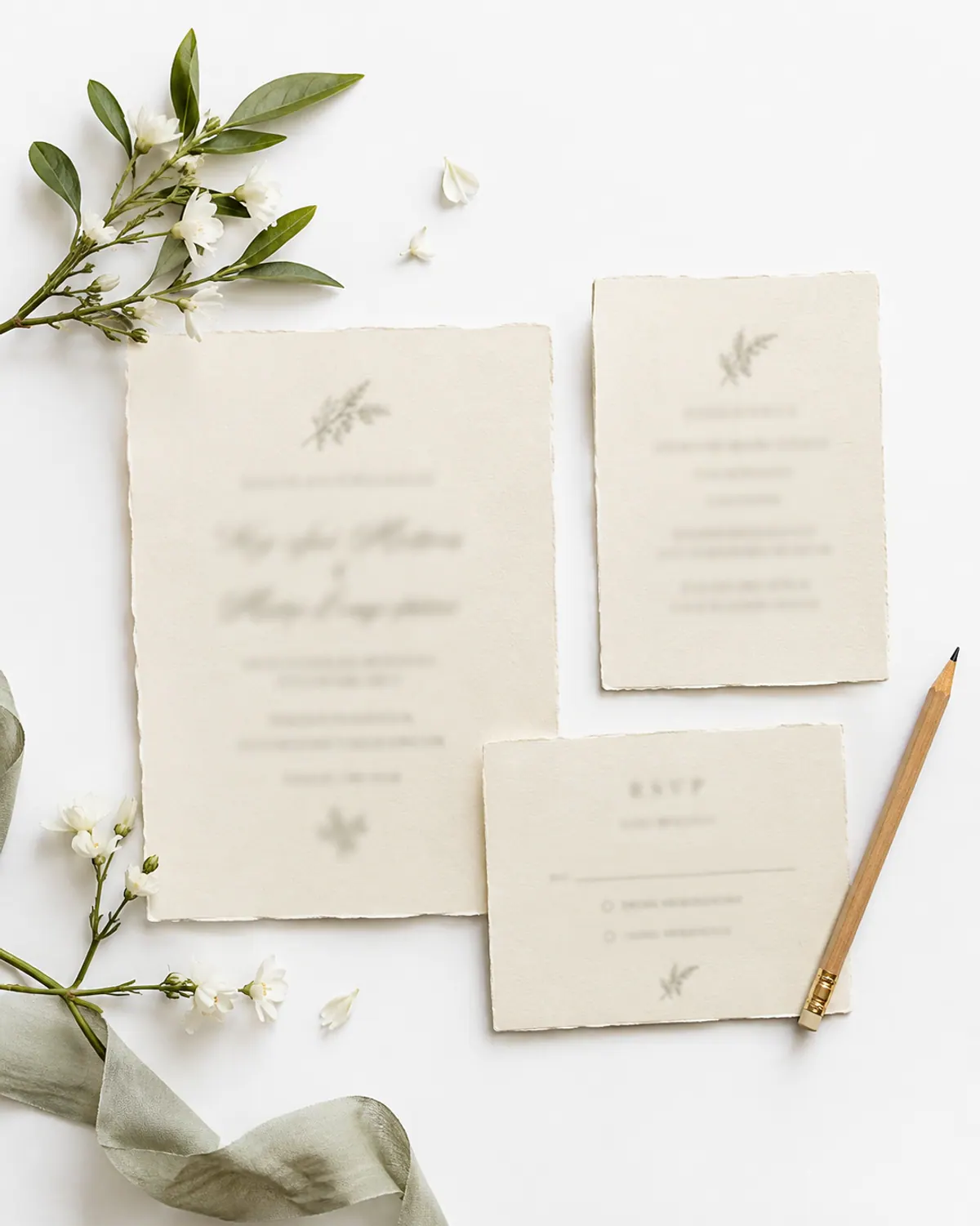
A full suite can mean an invitation, an RSVP card with its own envelope, a details card and a reception card. Each piece adds printing, paper and postage weight. Joy reports that a full suite averages $518 and the invitation alone $226, and that gap gives you a sense of what the extras add.
Start with the invitation and move the rest to a wedding website: schedule, hotel notes, directions and the registry. Keep a printed card only for something guests cannot look up later, such as a shuttle pickup time. Fewer pieces make every other idea on this list cheaper as well.
Guests rarely miss a card they never knew existed, and a short, clean invitation is easier to read. Check your venue contract for anything guests must be told in print, and keep that line on the card.
- Tip: Lay out the suite you were about to order, then cross off each piece a website could replace.
2Count households, not guests
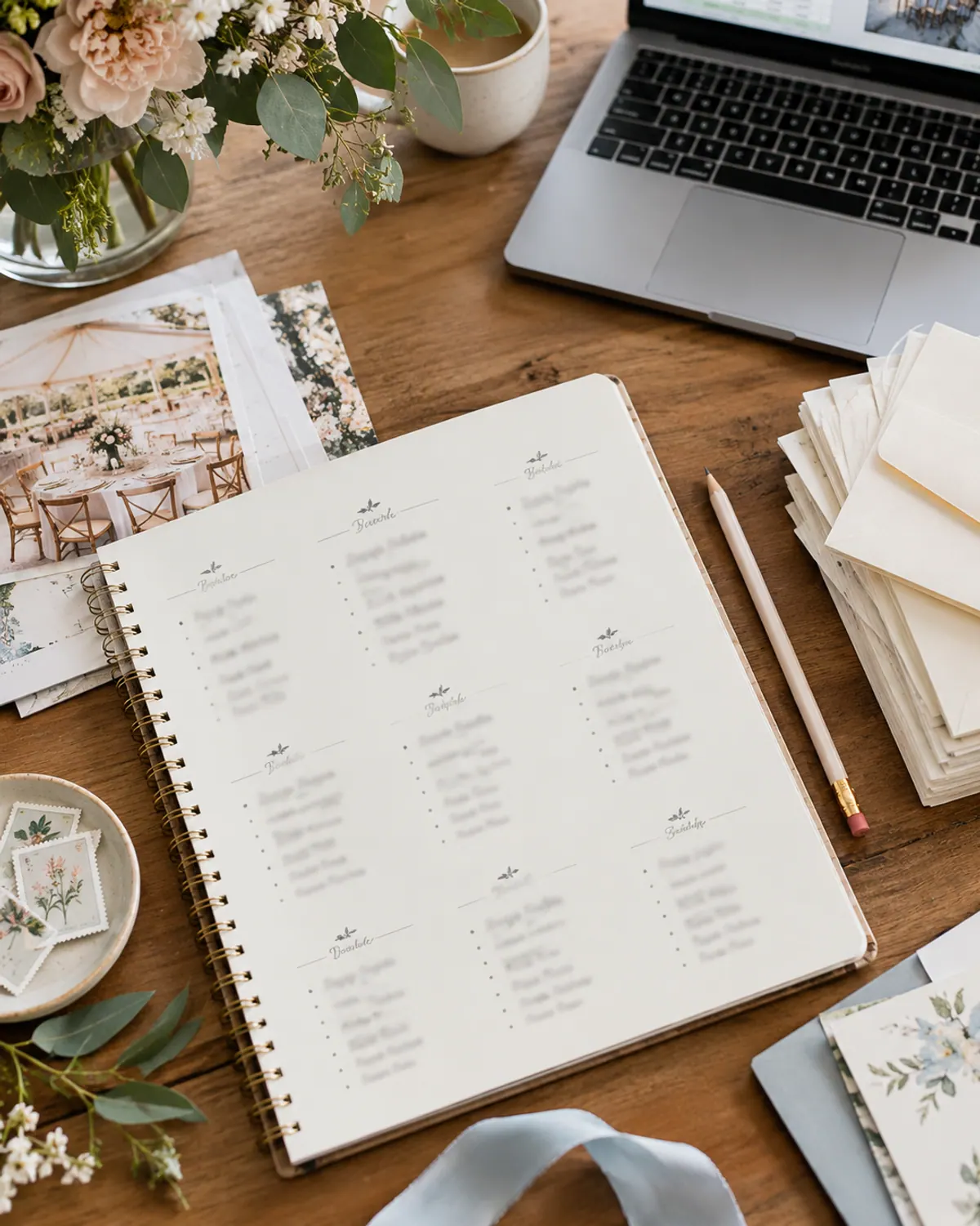
A couple or a family under one roof needs one invitation, not one each. Joy suggests ordering one per household plus a 15 to 20 percent buffer for typos, late additions and keepsakes.
Group your list by address before you ask any printer for a quote. Our guest list template by household does this in a spreadsheet. The count matters because Joy reports invitations alone averaging $123 for 50 or fewer guests, $185 for 51 to 100 and $276 for 101 or more. A tighter list shrinks the print run, and trimming the guest list shrinks it further.
Remember adult children at their own address, and decide early how you will handle plus-ones, since that changes the count. Write the final household number at the top of your spreadsheet and reuse it in every quote.
- Tip: Address each household once and write the number of people on your list beside it.
3Move the details to a wedding website
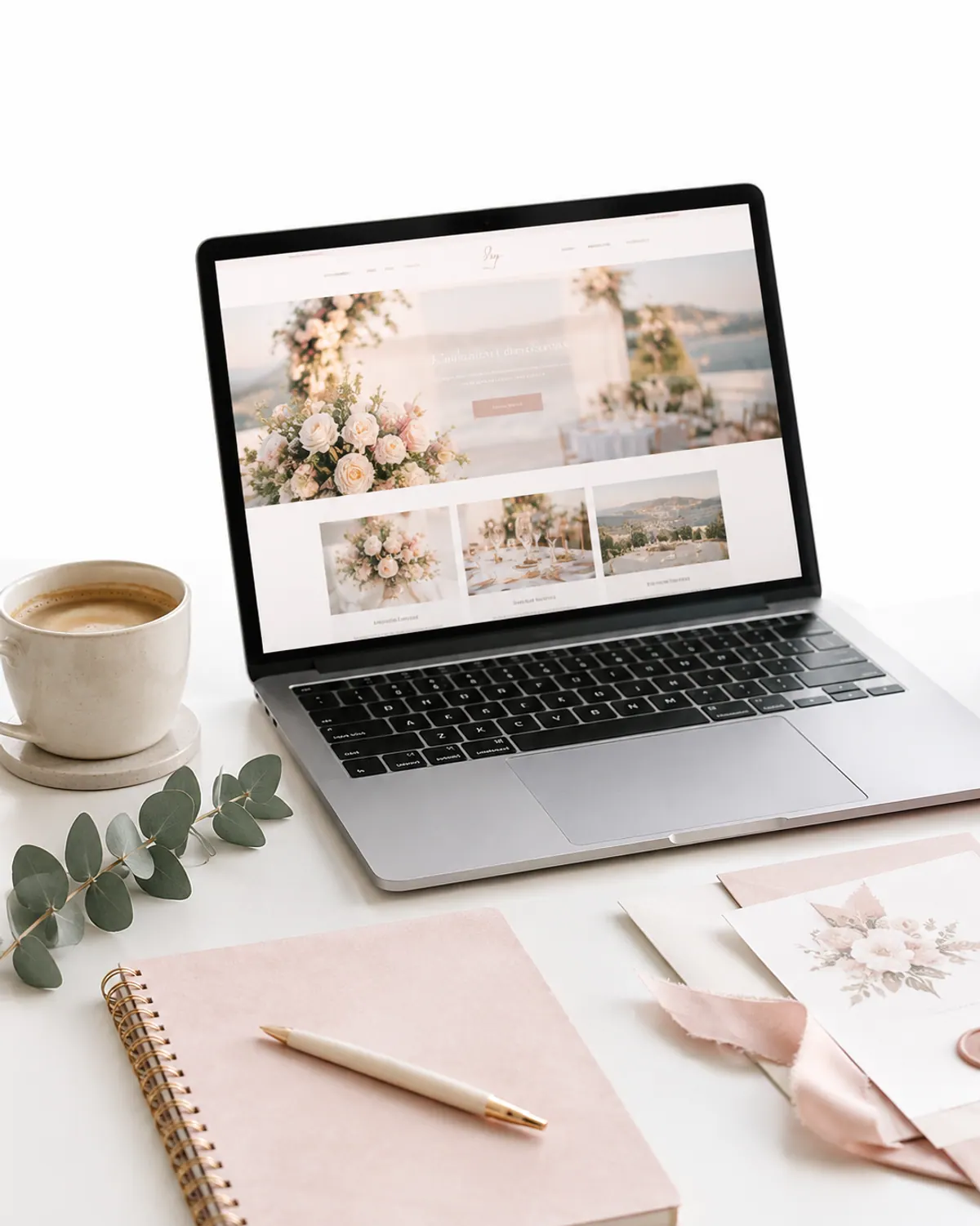
Directions, parking, hotel blocks and dress notes fit on a free page far more easily than on a card. Several wedding platforms offer a free site, so compare before you pay for one.
Put one short web address on the invitation, or a small QR code if the printer can add it. Guests who prefer paper can ask you or a family member. Check the site on a phone before you print, since most guests will open it there. If the page changes later, you only edit it once instead of reprinting a card.
Many couples add a short note on the invitation such as details online, so guests know where to look. Keep the page simple, with a clear schedule, a map link and the RSVP form near the top.
- Tip: Print the web address in plain type and test it by typing it into a phone, not by clicking a link.
4Send the save-the-date digitally, or skip it
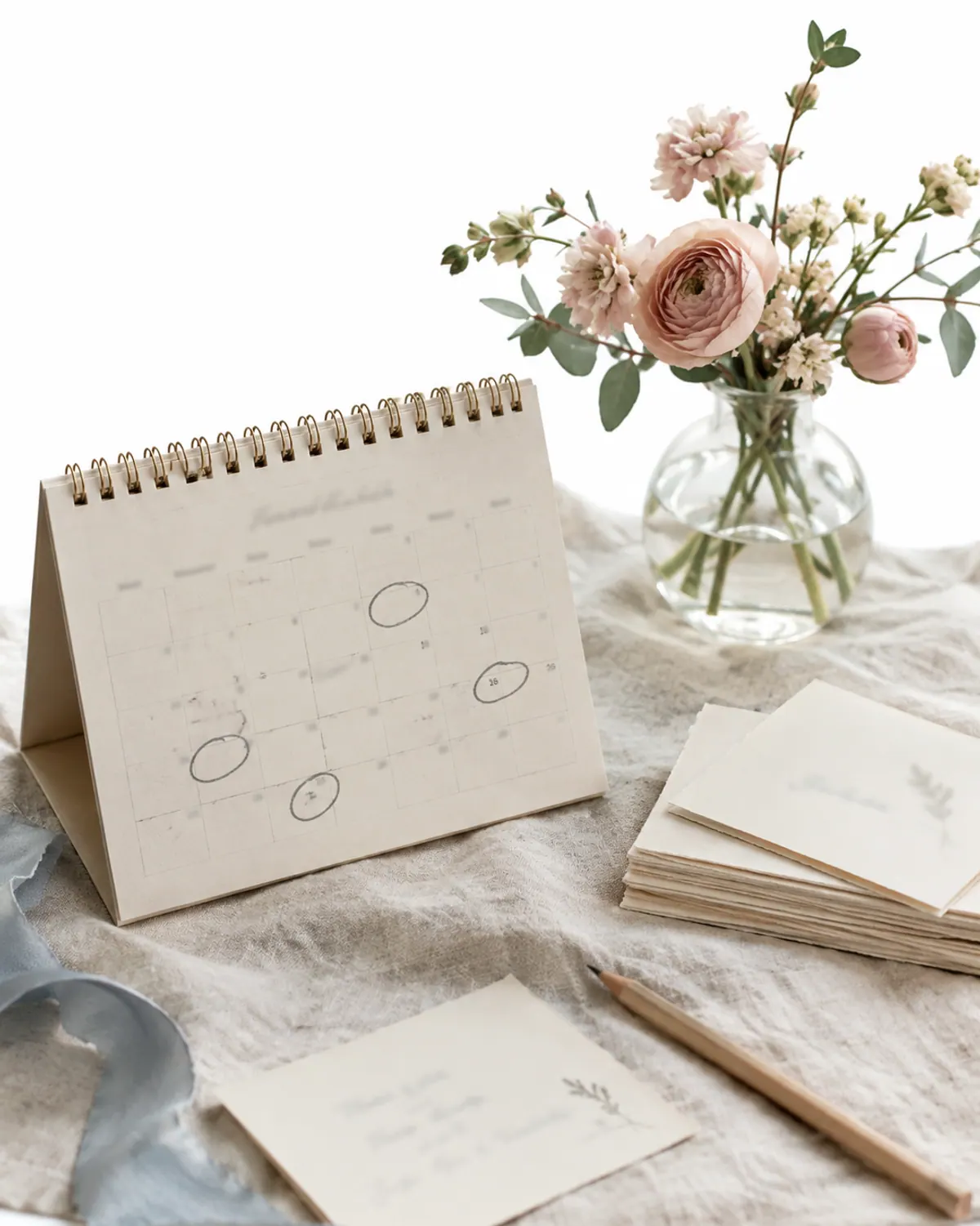
Joy puts save-the-dates about 6 to 8 months before the wedding, and 8 to 12 months for a destination wedding. A save-the-date matters most when guests must travel or book time off. For a local wedding with a short list, you can go straight to the invitation.
When you do send one, a text, email or simple online card costs far less than printed cards with stamps. Our save-the-date timing and cost guide has send-by dates for every wedding month. Mail paper only to the guests who would rather have it.
If you decide to skip it, add the date and city to your engagement announcements or family group chat so nobody books a conflicting trip. The goal is notice, and the format matters much less than the timing.
- Tip: Ask yourself who truly needs advance notice, and send the early note only to them.
Cheap Wedding Invitation Design Options
5Edit a template and print it yourself or at a print shop
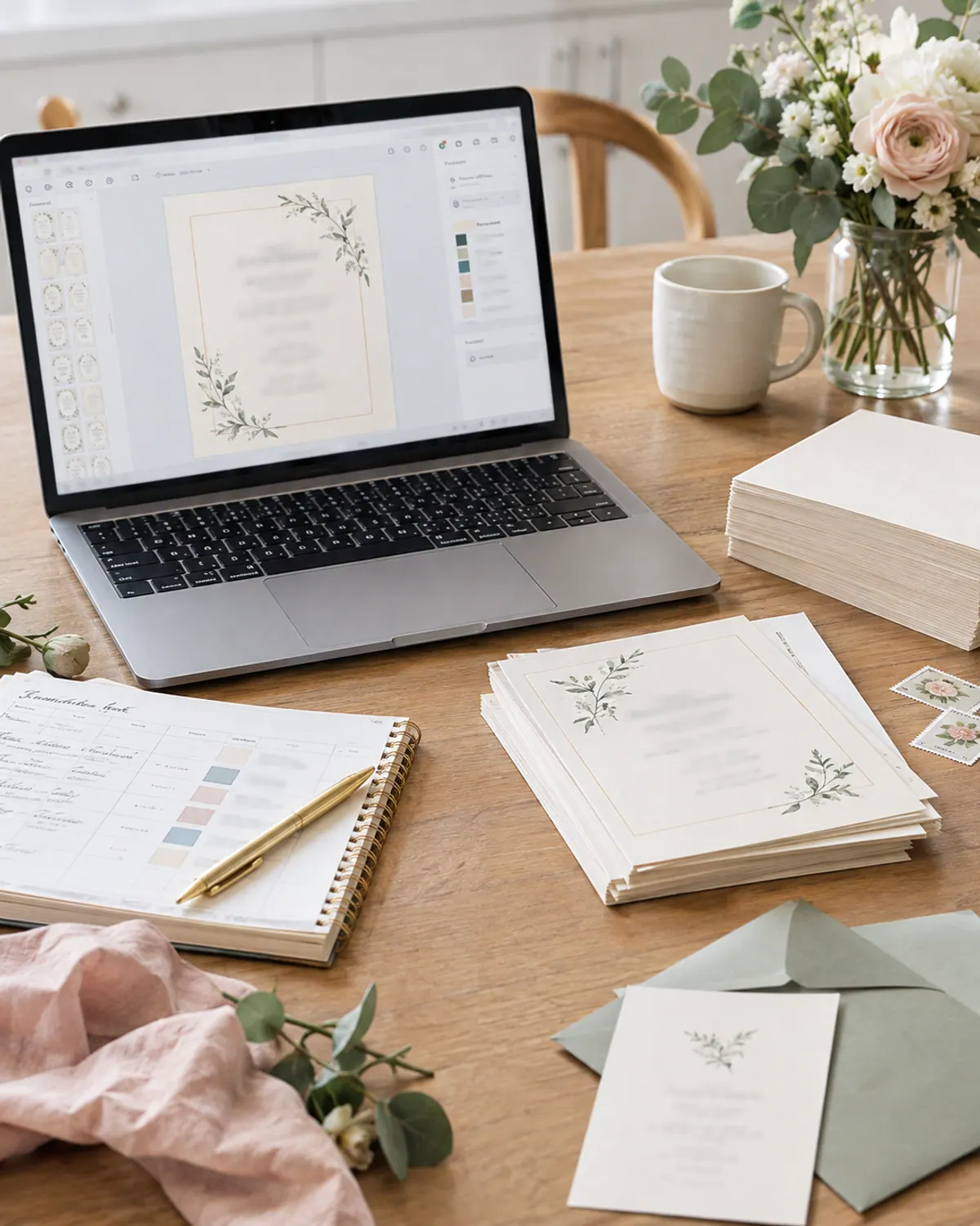
An editable template lets you change names, wording and colors, then print at home or at a copy shop. A stationery studio guest post on Klem Studios' blog puts pre-designed print-yourself suites at about $1 to $2 each, or $100 to $200 per 100 (source). That is a search snippet, so confirm current prices.
Our templates versus printer versus stationer comparison prices four routes for 100 invitations. Check the template license first, since some allow only personal printing. Proof the file at actual size on plain paper before you buy cardstock.
Choose fonts that are easy to read at small sizes, and keep the colors to two or three so the printer or your home ink does not struggle. A simple design also survives small printing flaws far better than a busy one.
- Tip: Print one test copy on plain paper and check margins and spelling before using good paper.
6Order a basic design from an online printer
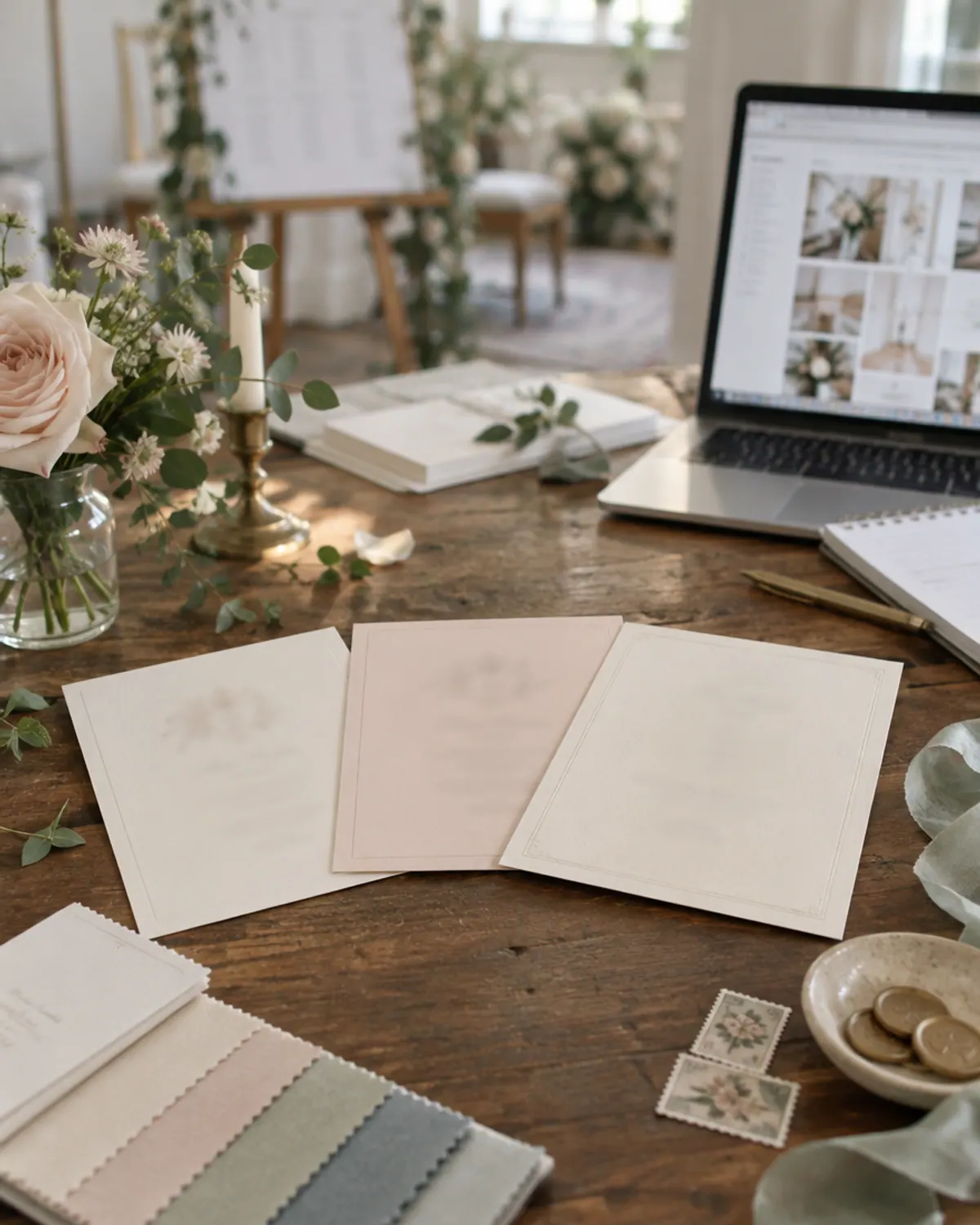
Pre-designed suites from online printers cost far less than custom work. In its list of affordable invitations, Joy reports prices such as Basic Invite monogram designs from $0.72, Zazzle geometric designs from $1.44, The Knot basic designs from $1.99 and Minted scribble-style designs at $2.50 to $6.00 (Joy's list, 2025).
Joy is not consistent about whether these are per invitation or per set, so read the checkout total. Add envelopes, shipping and any proof fee. Ordering an inexpensive sample first shows you the paper weight before the full print run.
Look for printers that show a proof before they print, and read their return and reprint policies. Standard sizes keep both the price and the postage down, so avoid shapes that need special envelopes unless you really love them.
- Tip: Compare printers by the final total with envelopes and shipping, not by the starting price.
7Send digital invitations
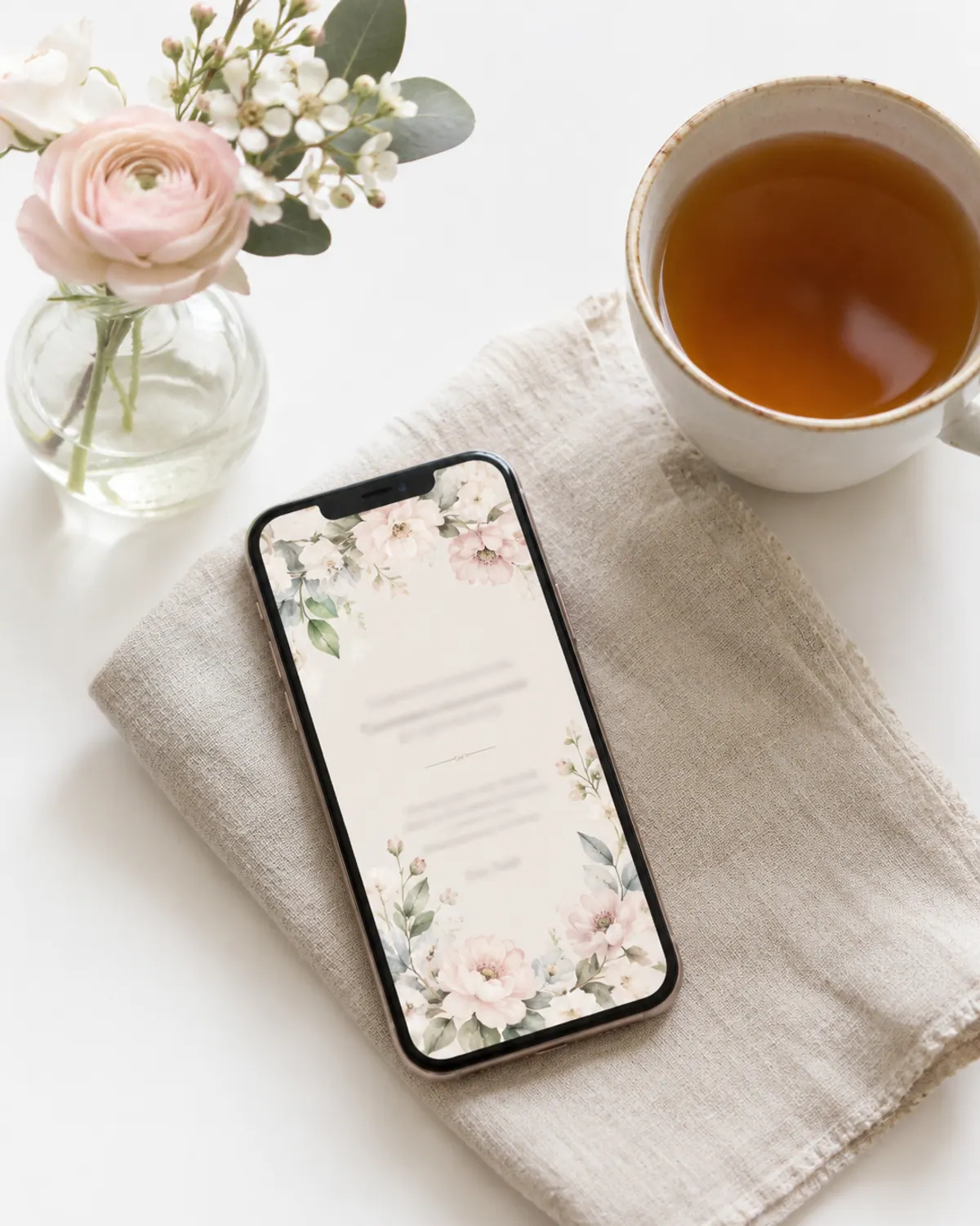
Joy lists customizable digital sets at $0.99 to $1.99 (Joy's list), and some services have free options. Digital invitations skip printing, envelopes and stamps, and RSVPs arrive in one place.
They suit casual and most semi-formal weddings. Black-tie and traditional religious ceremonies often still call for paper. Our digital wedding invitations guide covers etiquette and costs. A hybrid works well too: send digital invitations to most guests and mail a small batch of paper copies to relatives who do not use email.
Send them through a service that tracks opens and replies, and address each message to one household so nobody guesses who is invited. Start the RSVP clock the day they go out, and send one gentle reminder before the deadline.
- Tip: Add a plain-text backup, such as a phone number, for guests who miss emails or texts.
8Choose a single-card invitation
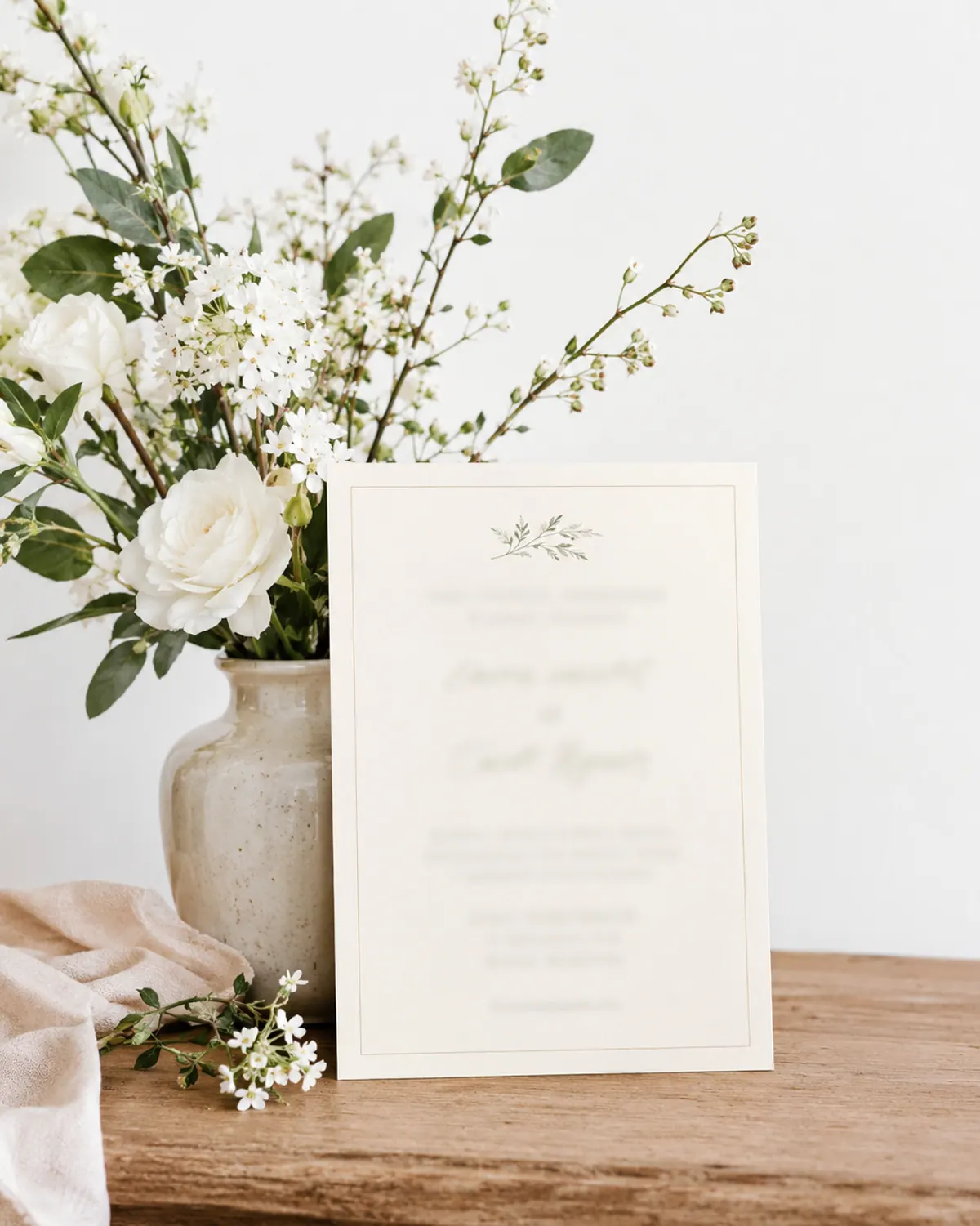
A flat single card with the RSVP link or QR code printed on it removes the RSVP card, its envelope and its stamp. One layer also weighs less, which keeps postage lower. Postcard-style invitations can mail at a lower rate than a letter when they meet USPS size rules, so ask the post office before you design one.
This suits casual weddings best. For a formal evening, a single card in a lined envelope can still look polished. Choose a clean layout with generous white space, because crowded text is the fastest way to make a simple card look cheap.
Keep the wording short and put the date, time, place and website in clear order. If the card has a photo or color block, check that the text stays easy to read where it overlaps, and print a sample first.
- Tip: Ask the post office to approve a mock-up before you order the full run.
9Print at home on good cardstock
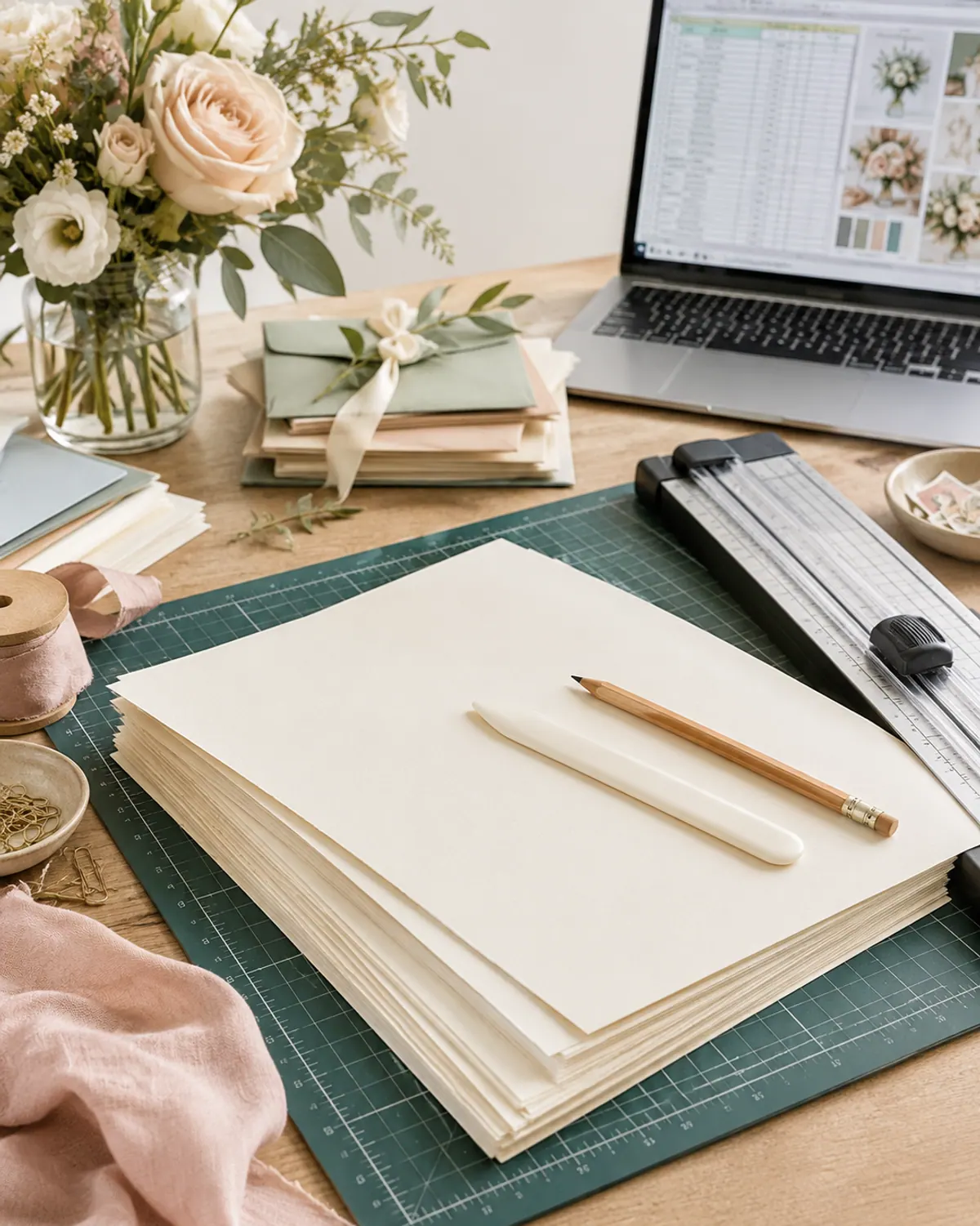
If you have a reliable printer and a free weekend, home printing can be the lowest cost route. Buy ivory or white cardstock sized for your design, a paper trimmer and, if needed, a bone folder for crisp edges. Check the weight your printer accepts before ordering.
Print a short batch first, let the ink dry fully and stack with sheets of plain paper between them. Plan for misprints and trimming errors by ordering 15 to 20 percent more cardstock than your household count, the same buffer Joy suggests for invitations.
Matte paper takes ink more evenly than glossy stock, which can smear. If a design runs to the edge, print at a copy shop instead, since most home printers leave a white border around the page.
- Tip: Do the whole run over two or three evenings, not one night, so mistakes surface early.
Gives a printed invitation a heavier, more finished feel.
Paper, Envelope and Finishing Choices That Cut Cost
10Stick to standard sizes and shapes
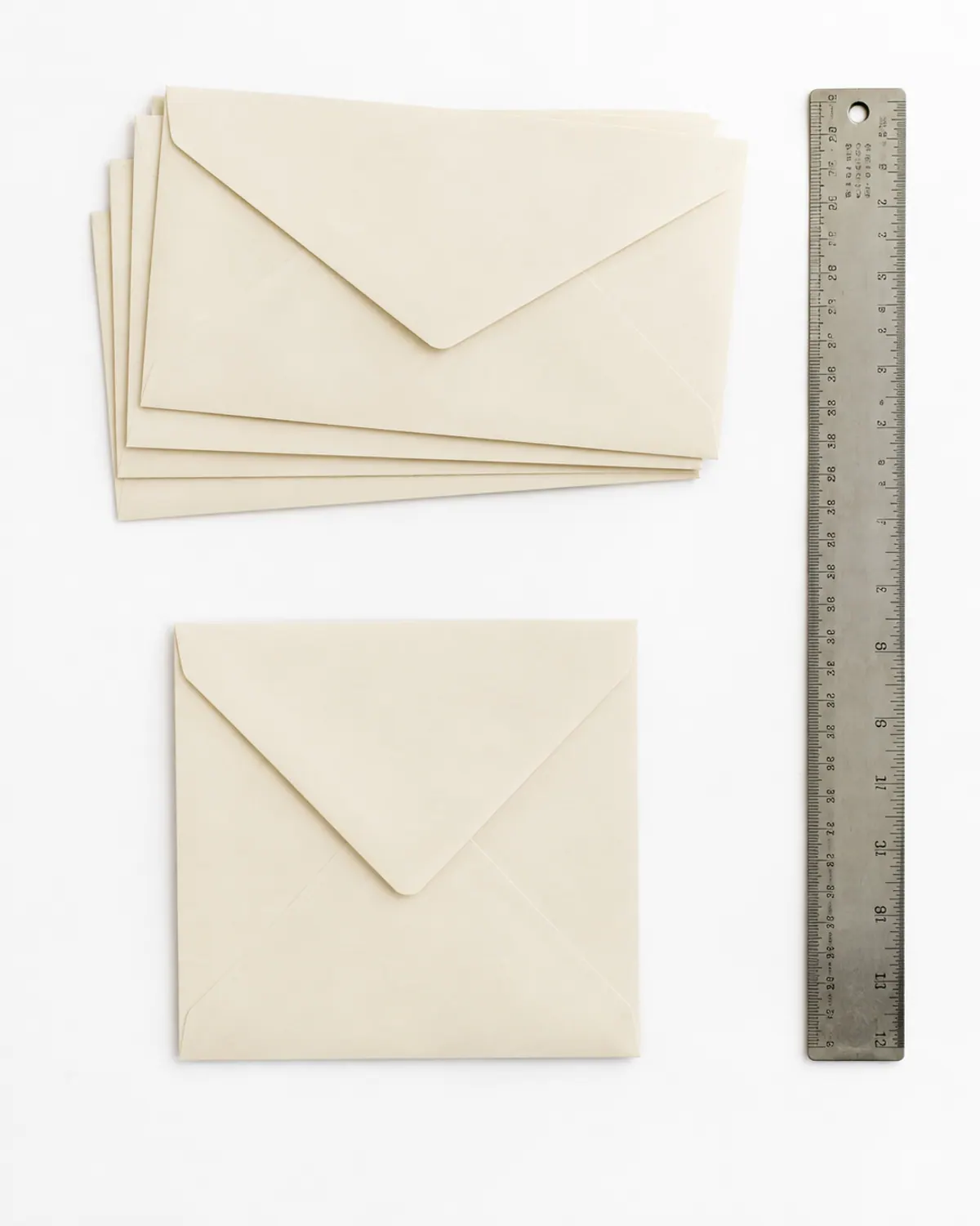
Square, extra tall or rigid invitations can mail as non-machinable, and Joy reports a surcharge of $0.46 on top of postage. On 100 mailed invitations, that is $46 extra for one design choice.
Standard rectangular sizes, such as 5 by 7 inches in a matching envelope, tend to avoid the surcharge. Ask the post office to check your sample before you order, because the rules depend on shape and thickness. A square card can still work if you accept the added cost, but make that a choice, not a surprise.
If you love a square design, ask your printer whether they offer it in a size that still counts as standard. Otherwise, choose a regular rectangle for the envelope and let the card inside carry the style.
- Tip: Measure your envelope and ask the post office whether it mails as a standard letter.
11Pick one finishing touch, not four
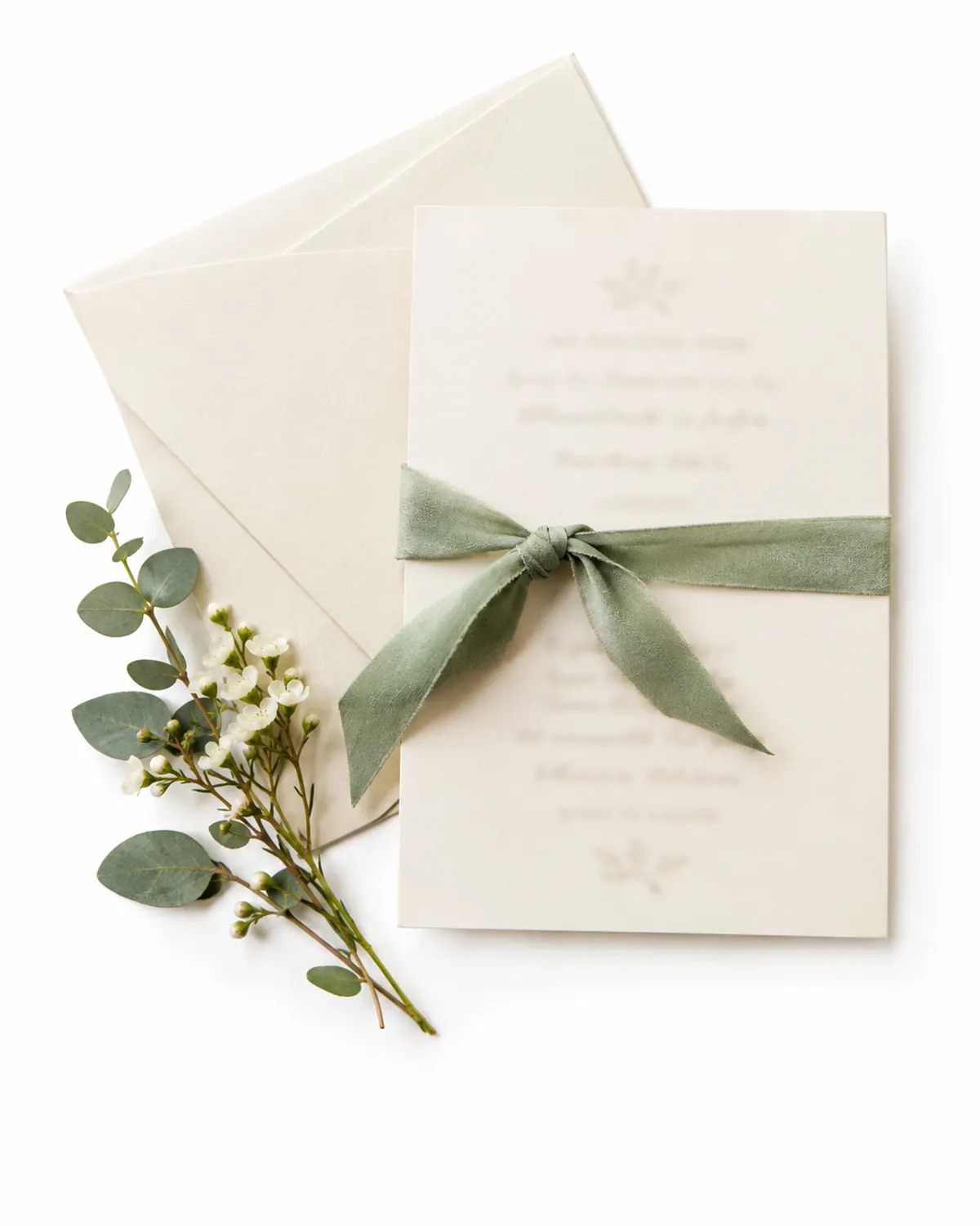
Ribbon, wax seals, vellum wraps and envelope liners each add cost and weight. Joy reports an extra $0.28 for each additional ounce of postage, so a heavier suite can raise the stamp price on every envelope.
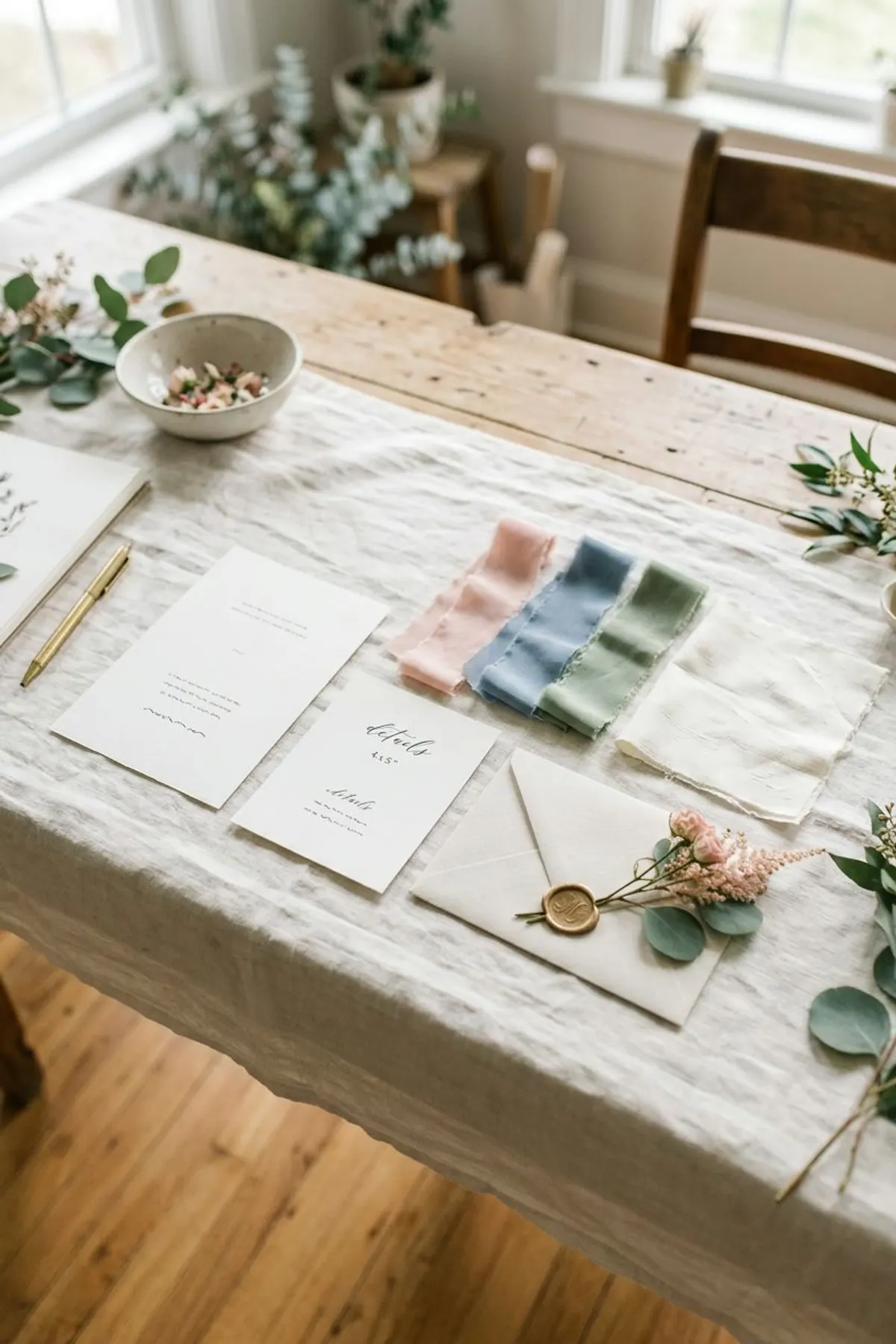
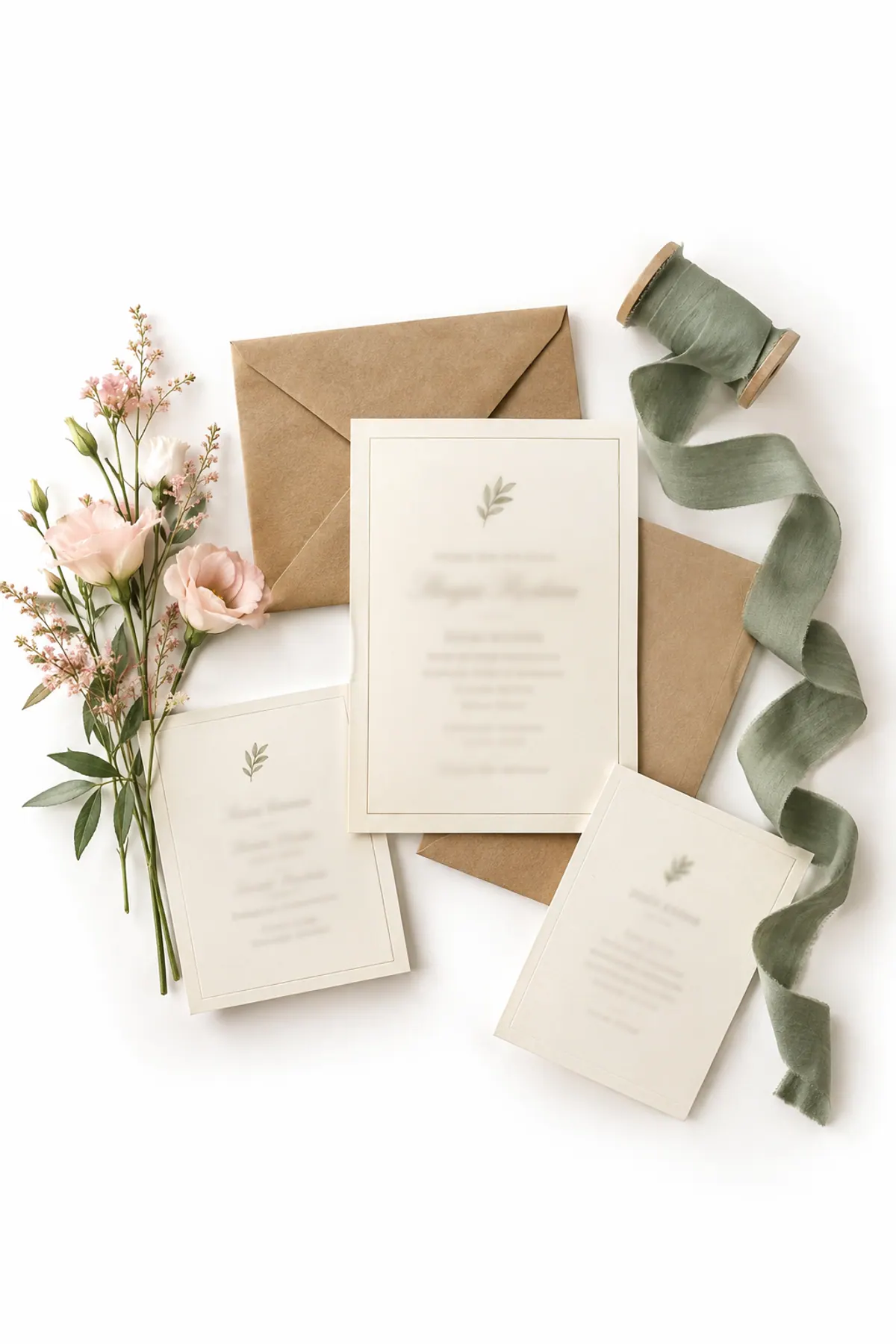
Choose one detail that suits your wedding, such as a ribbon tie or a printed envelope liner, and skip the rest. Plain paper with good type looks clean, and it photographs well for your invitation flat lay. A single finishing touch also takes less time at assembly, which matters when you are stuffing envelopes by hand.
Guests notice the wording and the colors long before they notice the seal. If you want a keepsake feel, put the effort into one small detail they will touch first, like the paper weight or the envelope color.
- Tip: Assemble one finished sample and weigh it before deciding which extras stay.
12Print the addresses or use labels
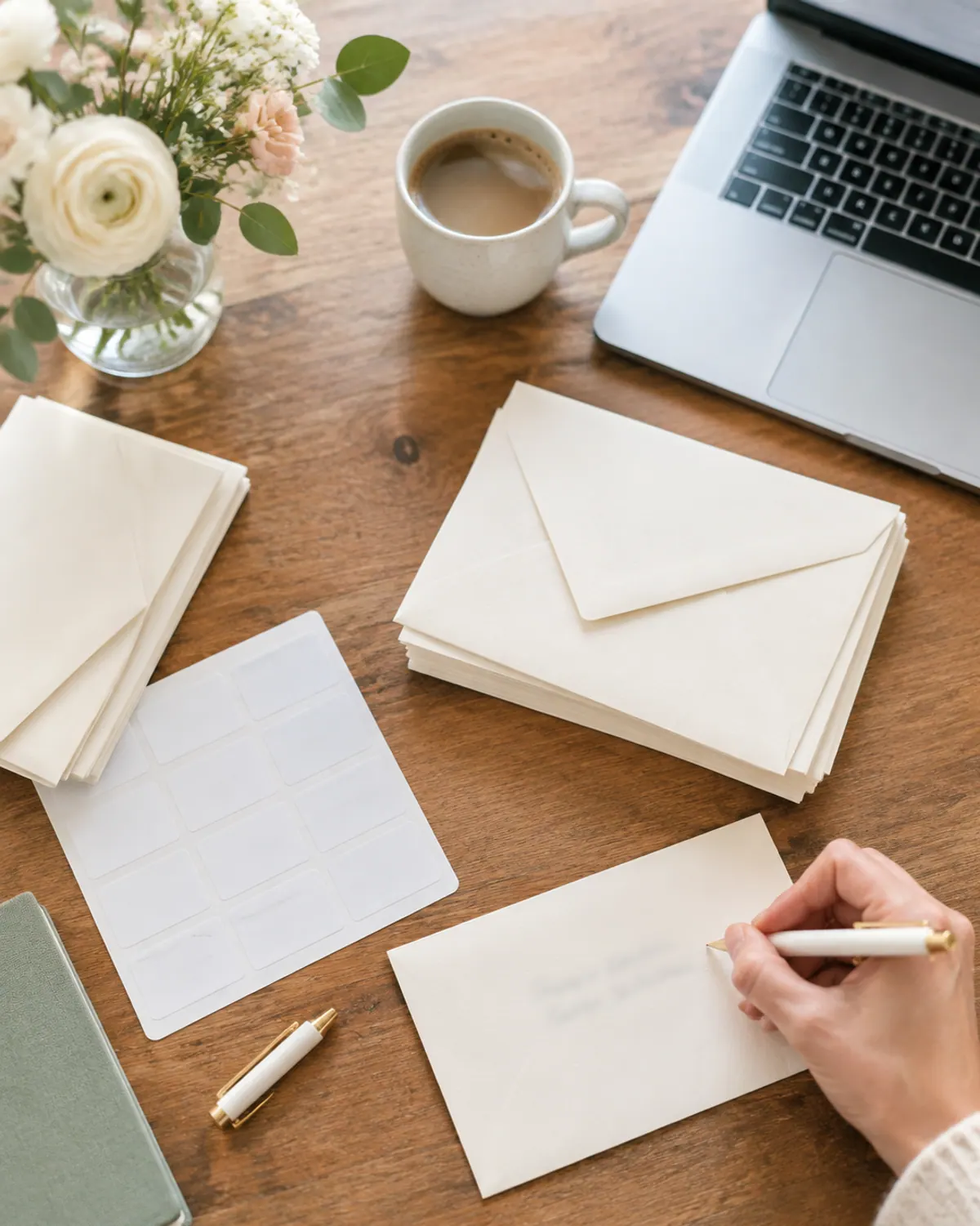
Hiring a calligrapher for every envelope can cost more than the invitations. A clean printed return address and printed labels, or direct printing on the envelope, cost a fraction of that. If you like handwriting, address a few evenings' worth at a time and keep a list.
Match your envelope formality to your wording. Our guide to invitation wording for every family situation shows how to write each name line. Use your household spreadsheet to run a mail merge and avoid retyping errors.
Test your printer on one envelope before running the stack, and keep a few spares for errors. Putting your return address on the back flap or front corner also gives the post office somewhere to send returns.
- Tip: Order 15 to 20 percent extra envelopes so a smudge does not hold up mailing day.
Print guest addresses from your spreadsheet instead of handwriting each envelope.
Postage, Quantity and Timing Ideas That Save Money
13Replace the mailed RSVP card with an online RSVP
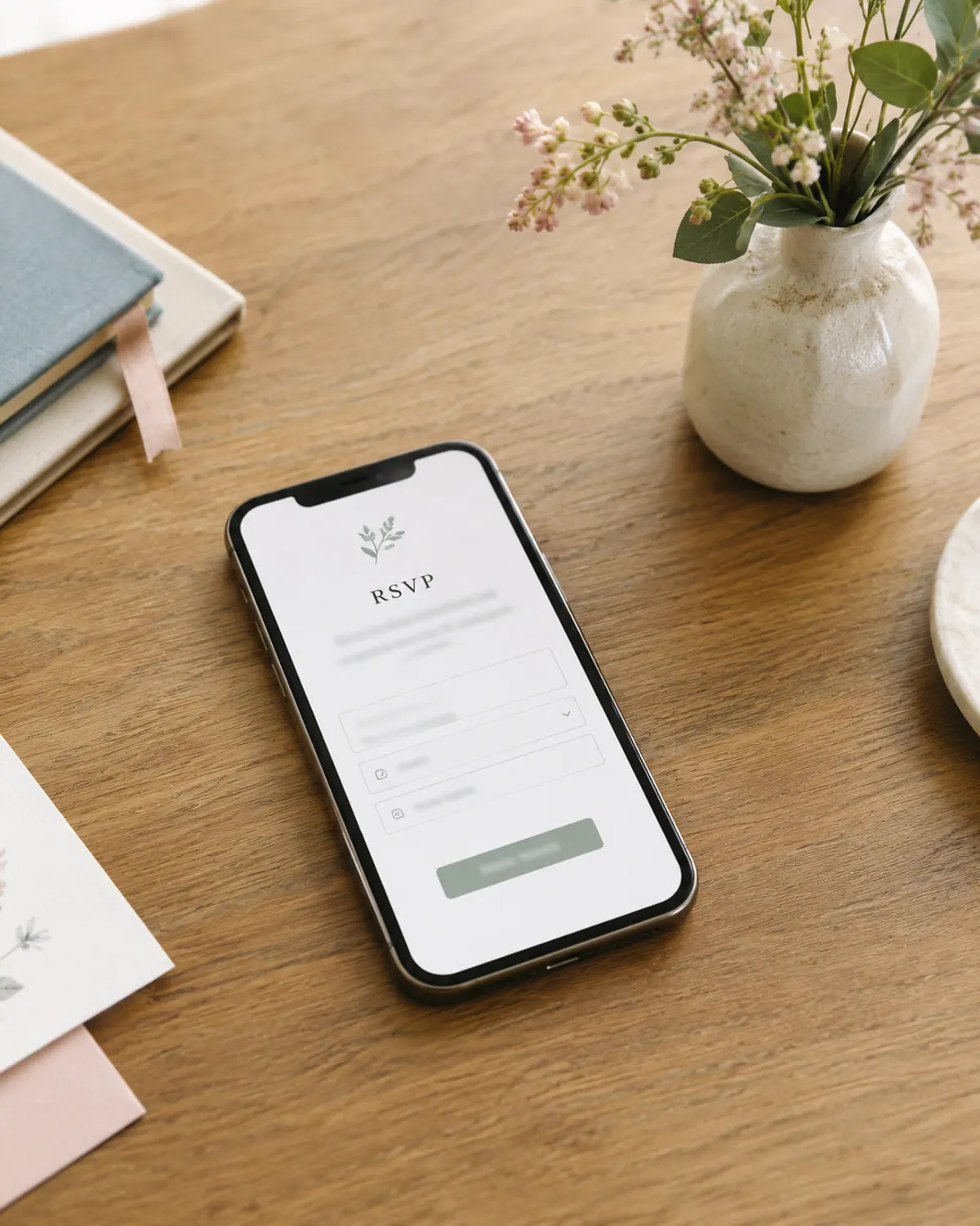
A mailed response means paying for a card, an envelope and return postage, which Joy puts at $0.73 per RSVP. An online form costs nothing on most wedding websites and delivers answers in one list.
Set a clear reply-by date and put a phone number on the website for guests who do not use the internet. You can also add meal choices and song requests to the same form. Check your responses weekly so you can follow up with quiet households before your caterer's headcount date.
For older relatives, offer to fill in the form for them or add a small insert with a phone number. Include a line on the website explaining who the invitation names, so guests do not add extra people.
- Tip: Ask your caterer for their final headcount date and set the RSVP date before it.
14Weigh a finished sample before buying stamps
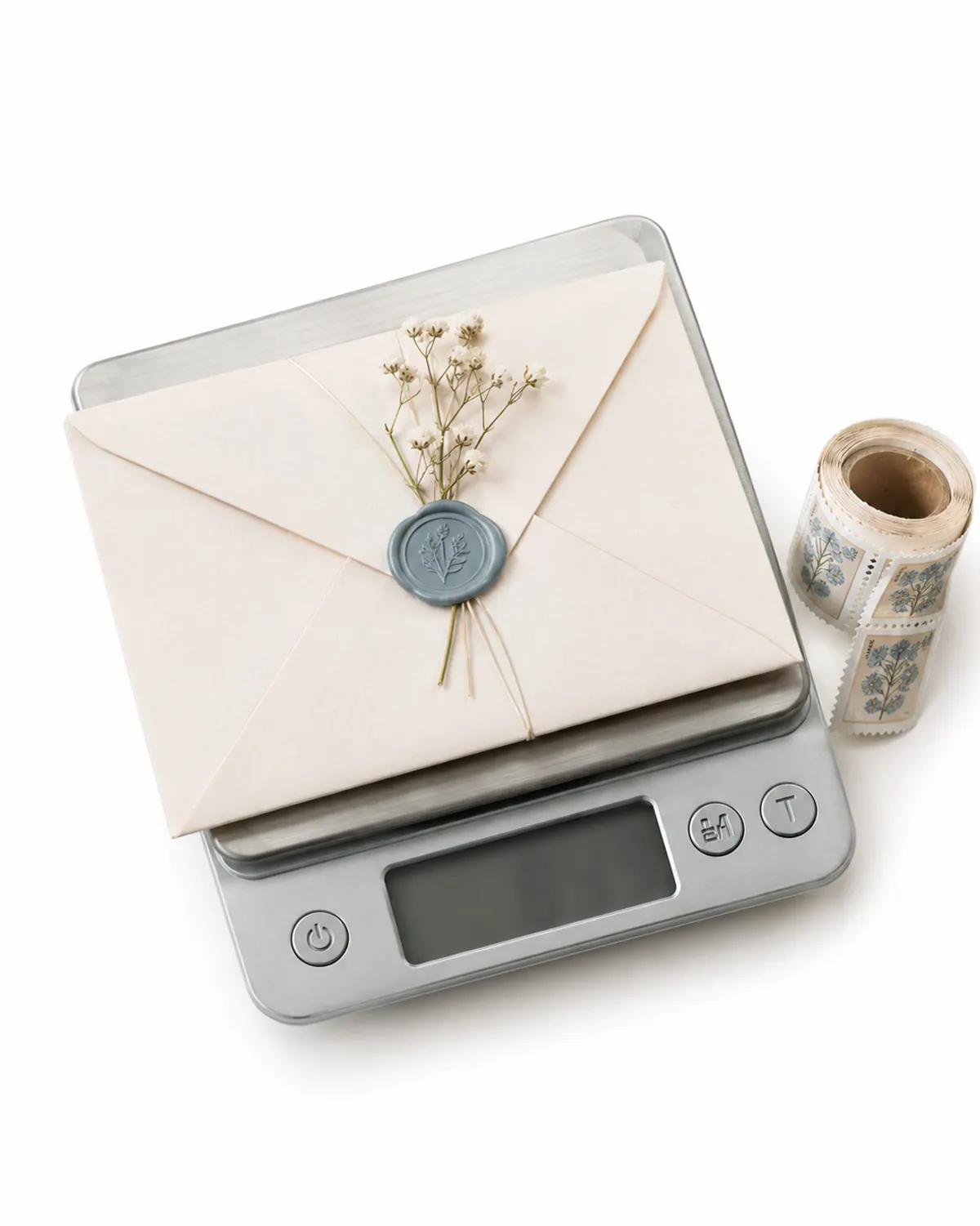
Postage depends on weight and shape. Joy reports an extra $0.28 for each additional ounce, so an invitation with inserts, a liner and a ribbon can cost more per envelope than a plain one. Assemble one complete suite, weigh it on a kitchen or postal scale and take it to the post office.
Ask for the exact price per envelope before you buy 100 stamps. Our hidden wedding costs guide covers other fees that tend to arrive after the quote.
Weights near an ounce can tip over, so test the sample with and without the final inserts. If the suite lands just over, remove one card or switch to lighter paper before you print all of them.
- Tip: Bring your sample, your envelope and a note of the household count when you visit the counter.
Weigh a finished suite at home before you buy stamps.
15Order once, with the buffer, and proof carefully
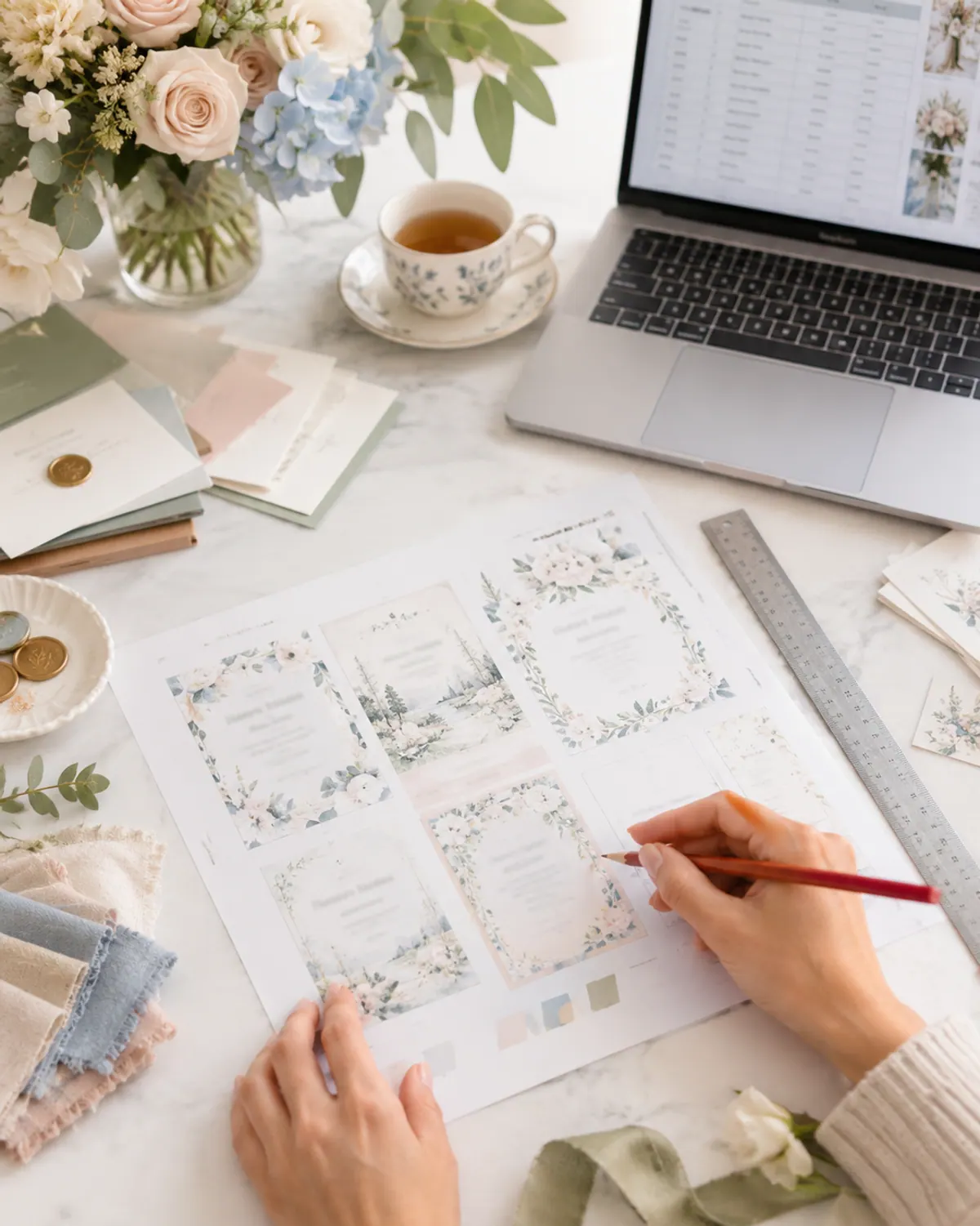
A typo found after printing means a reprint and a rush fee. Read every name aloud, check dates and times against the venue contract, and ask a second person to proof it. Then order the household count plus a 15 to 20 percent buffer, as Joy suggests.
The buffer is the cheaper choice because reprint runs usually cost more per piece than the original order. Keep the leftover cards for your own keepsakes. If you are still planning your overall spending, our budget wedding ideas guide shows where else the money goes.
If you have to reprint, ask the printer whether any pieces can be reused. A calm two-day proofing step before you order is far cheaper than fixing a wrong date on a stack of finished cards.
- Tip: Have someone who has never seen the details read the proof for dates and spellings only.
Bonus: Your Invitation Cost Worksheet and Send Timeline
Most cost pages mix prices per invitation, per set and per 100, so the totals are hard to compare. This worksheet counts per household, which is how you actually buy. The example uses 50 households, which is an assumption for illustration, not an average.
| Line | How to figure it | Example for 50 households |
|---|---|---|
| Pieces to order | Households plus 15 to 20 percent buffer | 58 to 60 pieces |
| Printing | Pieces times price per piece. Joy lists examples from $0.72 to $6.00, labeled per invite or per set | About $42 to $360 |
| Outgoing stamps | Households times the current USPS rate for your weighed sample | Your rate times 50 |
| Paper RSVP return stamps (skip with an online RSVP) | Households times $0.73 (Joy) | $36.50 |
| Non-machinable surcharge (square or rigid) | Households times $0.46 (Joy) | $23 |
| Extra ounce (heavy suite) | Households times $0.28 (Joy) | $14 |
| Envelopes, labels, shipping | From your printer quote and a labels pack | Add your quote |
| Total and cost per household | Add the lines, then divide by households | Your total divided by 50 |
For comparison, Joy reports invitations alone averaging $123 for 50 or fewer guests, $185 for 51 to 100 and $276 for 101 or more, and a full suite averaging $518. Joy's own digital and print figures are inconsistent between pages, so treat them as reference points, not targets, and put your own quotes in the worksheet.
| When | What to do |
|---|---|
| 6 to 8 months before the wedding | Send save-the-dates if guests must travel (Joy). Use 8 to 12 months for a destination wedding. |
| After the save-the-dates | Finish the household list, check every address and decide how many pieces to order. |
| Before you order | Weigh a finished sample, get the exact postage price and ask the printer for turnaround and proof time. |
| Order date | Mail date minus the printer turnaround, plus a few spare days for one proof fix. |
| 6 to 8 weeks before the wedding | Mail or email invitations. This is the window our digital invitations guide gives, citing Joy. |
| RSVP deadline | Set it before your caterer needs a final headcount. Ask the caterer for that date. |
Before you place the order
Helpful supplies for budget invitations
-
Ivory cardstock, 5 x 7 invitation size
Typically $10 to $25
A heavier base for home-printed invitations.
Check price on Amazon for Ivory cardstock, 5 x 7 invitation size -
A7 envelopes
Typically $10 to $25
The standard size for a 5 by 7 card, which avoids the square-envelope surcharge.
Check price on Amazon for A7 envelopes -
Blank white address labels
Typically $8 to $20
Print guest addresses from your spreadsheet.
Check price on Amazon for Blank white address labels -
Digital postal scale
Typically $10 to $25
Weigh a finished suite before you buy stamps.
Check price on Amazon for Digital postal scale -
Paper trimmer
Typically $15 to $35
Clean, straight edges when you cut your own cardstock.
Check price on Amazon for Paper trimmer
Put the Savings Into a Real Plan
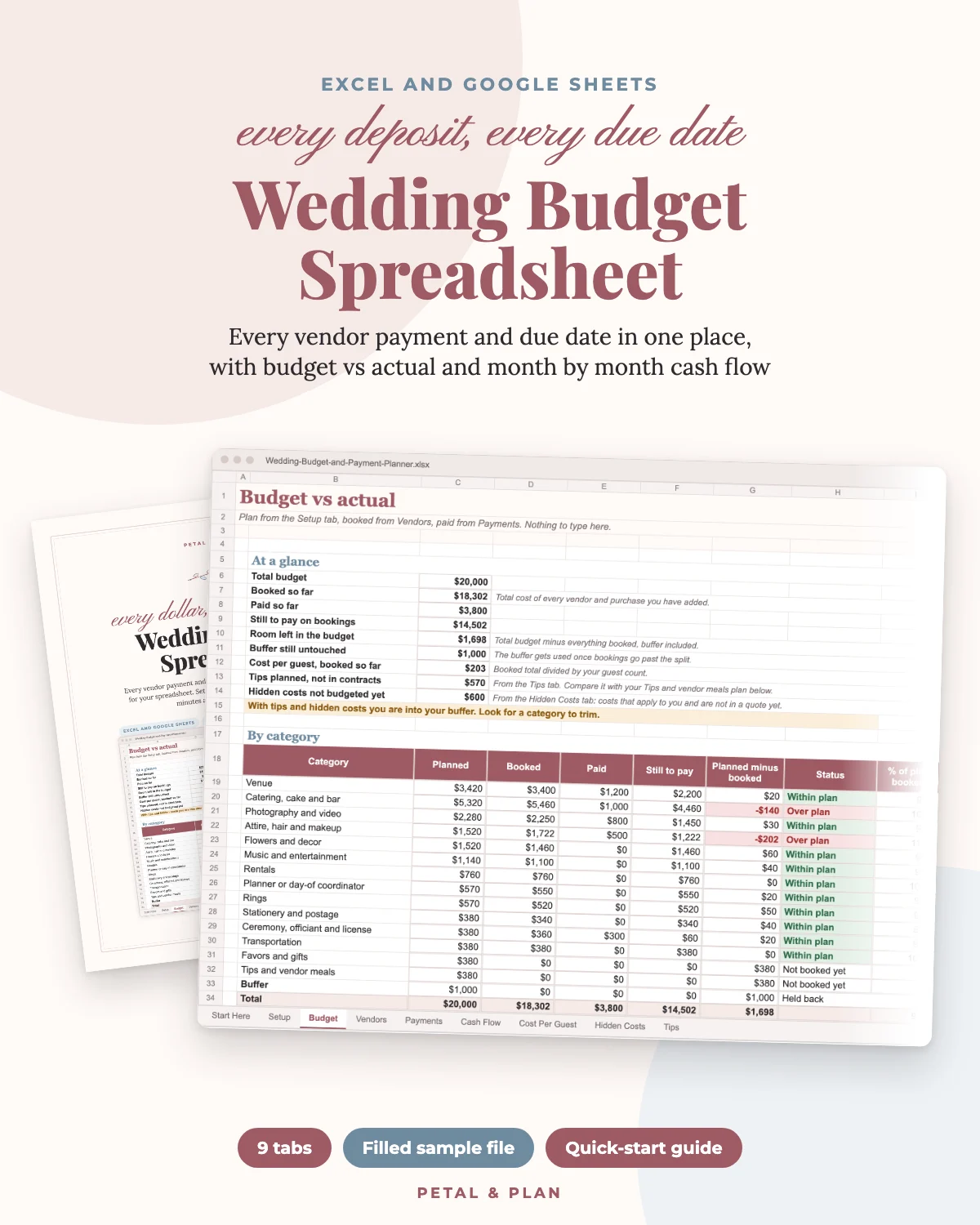
Invitations are one line in a bigger budget. Our Wedding Budget & Payment Planner splits your total across 14 categories with a buffer and tracks each vendor's fees and due dates, so stationery savings go where you want them. Code PETAL20 takes 20 percent off. Prefer to start free? The wedding budget cheat sheet is a one-page way to set your totals. For the full picture, see how to plan a wedding on a budget and the wedding budget spreadsheet template.
Frequently asked questions
What is the cheapest way to do wedding invitations?
Digital invitations or an editable template you print yourself. Joy lists customizable digital sets at $0.99 to $1.99, and a studio blog puts print-yourself suites at about $1 to $2 each. Add postage, envelopes and your time before you decide.
How many wedding invitations do I need?
One per household, plus a 15 to 20 percent buffer for mistakes and keepsakes, as Joy suggests. A couple or a family at one address counts once.
How much do wedding invitations cost?
Joy reports an average full suite of $518 and invitations alone of $226 (updated June 22, 2026). By guest count, it reports $123 for 50 or fewer, $185 for 51 to 100 and $276 for 101 or more. Quotes vary by printer.
When should you send wedding invitations?
The usual window is 6 to 8 weeks before the wedding, with save-the-dates 6 to 8 months out and 8 to 12 months for a destination wedding. Set the RSVP date before your caterer needs a headcount.
Do I need an RSVP card?
No. An online RSVP on your wedding website replaces it, and it saves the card, envelope and return postage that Joy puts at $0.73. Add a phone number for guests who prefer to call.
Save it for later
Pin this to your Invitations, Vows & Speeches board so it's there when you need it.
Save to Pinterest