Safety first: Prices are examples with an as-of date. Always confirm with your own vendors. Please read our editorial guidelines before you start.
Key takeaways
- Invitations go to households, but food and chairs go to people. Track both.
- Write your plus-one and kids rules before you add a single name, then apply them the same way to everyone.
- An A list and a B list let you invite more people only as declines come in.
- Plan headcount with a yes rate, but treat it as a guess, not a promise.
- At The Knot's 2026 average of $292 a guest, every 10 guests adds about $2,920.
In this post11 sections
- Why Build Your Guest List by Household
- What You Need Before You Start
- The Columns for Your Wedding Guest List Template
- How to Build a Wedding Guest List Template in 5 Steps
- Guest List Rules for Every Kind of Family
- The Headcount Math That Sets Your Budget
- Common Guest List Mistakes
- Variations: Google Sheets, Excel or Printable
- Skip the Build: Our Guest List & Seating Planner
- Next Steps After the Guest List
- FAQ
Why Build Your Guest List by Household
Most free templates have one row per person. That's fine for counting, but invitations, envelopes and postage go to households. A family of four is one invitation and four meals.
When you track both, you know how many invitations to print and how many people to feed. The two numbers are never the same, and mixing them up is how couples order 150 invitations for a 150-person wedding when they needed about 85.
What You Need Before You Start
Gather before you build

The Columns for Your Wedding Guest List Template
Use two tabs. The Households tab is one row per invitation. The Guests tab is one row per person, linked by a household name or number.
| Column | What goes in it |
|---|---|
| Household ID | A number, so you can link guests to it |
| Name on envelope | How the invitation will be addressed |
| Mailing address | Street, city, state, ZIP |
| Side or group | Partner 1, Partner 2, shared friends, work, family |
| List | A or B |
| Invited count | How many people this invitation covers |
| Save the date sent | Yes or no, with the date |
| Invitation sent | Yes or no, with the date |
| Gift and thank-you | What they gave and when you sent the card |
| Column | What goes in it |
|---|---|
| Household ID | Matches the Households tab |
| Guest name | As it should appear on an escort card |
| Adult or child | Children often get a different meal or seat |
| RSVP | Yes, no or waiting |
| Meal choice | And any allergy or dietary need |
| Accessibility | Seat near an exit, away from speakers, step-free route |
| Table | Filled in when you make the seating chart |
With an RSVP column on every person, a simple count of "Yes" gives your caterer's number. In Sheets or Excel, =COUNTIF(D:D,"Yes") does it.
How to Build a Wedding Guest List Template in 5 Steps
-
Step 1: List everyone, with no cuts yet
Each partner writes every name they'd want, grouped by side and group. Add lists from anyone hosting or contributing. Don't cut while you write; that comes in step 3.
-
Step 2: Write your rules first
Decide your plus-one rule (for example, married, engaged or living together, or everyone), your kids rule (all kids, family only, or adults only) and whether coworkers come. Then apply each rule to every household the same way. That's what makes a hard no feel fair.
-
Step 3: Sort into an A list and a B list
Your A list is everyone you'd invite if the cap were the only limit. The B list is who you'd add as declines come in. Some planners advise one list only, since staged invitations can be noticed. If you use a B list, send those invitations at least 6 weeks before the wedding, and never after the RSVP date.
-
Step 4: Estimate your headcount
Not everyone you invite will come. A common planning guess is that 10 to 20 percent of guests can't make it, and the rate can be higher for destination or holiday weddings. Start with an 80 percent yes rate, then check the number against your venue cap and budget, not the other way around.
-
Step 5: Collect addresses, then track RSVPs and meals
Gather addresses before save the dates go out. When RSVPs come back, update each person's row, not just the household. Chase missing replies by phone a few days after your RSVP date, since your caterer needs a final count.




Guest List Rules for Every Kind of Family
There's no single right answer for any of these. The fair version is the one you can explain the same way to everyone.
Divorced or separated parents:
Give each parent their own share of the list, and agree on the number early. If one side is hosting or contributing more, say upfront whether that changes their share.
Blended families and stepfamilies:
List stepparents, stepsiblings and their families under whichever side they're closest to, and give each household its own invitation if they live apart.
Chosen family:
The people who raised you or show up for you belong on the A list, whatever the relationship is called. Put them under the side they're closest to.
Kids:
If it's adults only, say so on the envelope by naming only the adults, and on your wedding website. Many couples make one exception for immediate family or kids in the wedding party; if you do, apply it to every family the same way.

The Headcount Math That Sets Your Budget
Here's an example of how one list turns into three numbers: invitations, invited people and expected guests.
| Step | Number | How |
|---|---|---|
| Households on the A list | 85 | One invitation each |
| People invited | 150 | Adults and kids, from the Guests tab |
| Expected yes rate | 80% | A guess; update as RSVPs come in |
| Expected guests | 120 | 150 x 0.8 |
| Cost at $292 a guest | About $35,040 | The Knot 2026 average, for scale |
| Each 10 guests | About $2,920 | Same average |
Your cost per guest will differ. Run your total and guest count through our wedding budget calculator to see your own number.
Common Guest List Mistakes
Check your list for these

Variations: Google Sheets, Excel or Printable
What we like
- Google Sheets: free, both partners and parents can add names live
- Excel: works offline, good for large lists
- Printable: easy for relatives who don't use spreadsheets
Keep in mind
- Google Sheets: someone has to manage edit access
- Excel: emailing files back and forth splits versions
- Printable: no counts or formulas, so totals are by hand
A common setup is a shared sheet for the master list, with a printed page for parents who want to add names, which you then type in.
Skip the Build: Our Guest List & Seating Planner
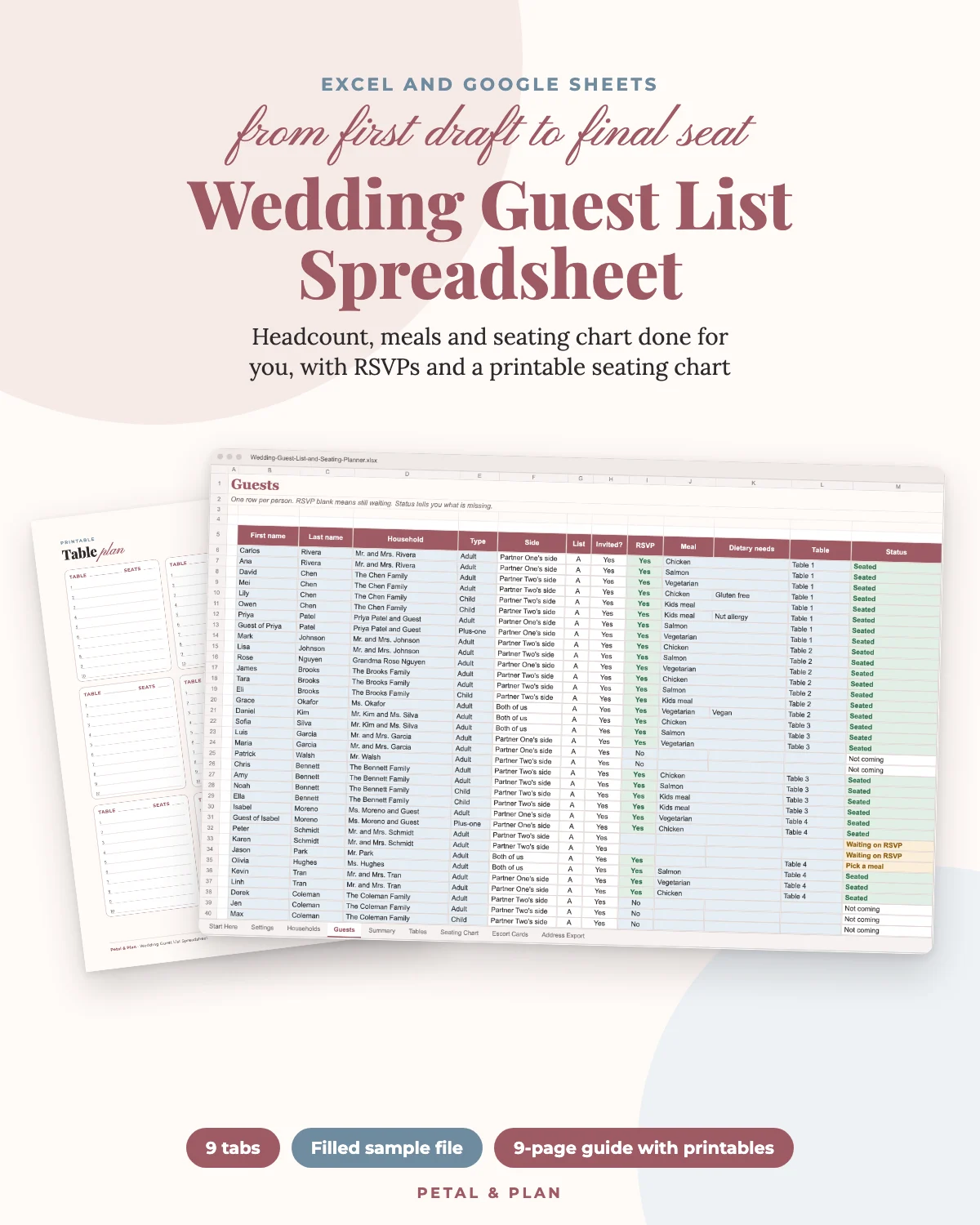
Our Wedding Guest List & Seating Planner has the Households and Guests tabs already linked. It tracks RSVP, meal and table status, shows expected headcount with a yes rate you can change (it starts at 80 percent), and has a B list switch.
It also includes Tables, a Seating Chart, Escort Cards, an Address Export CSV and gift and thank-you tracking, for up to 150 households, 300 guests and 40 tables. Code PETAL20 takes 20 percent off.
Next Steps After the Guest List
Once RSVPs are in, use our guide to making a wedding seating chart. For the envelope and invitation lines, see our wedding invitation wording for every family situation.
Add the save the date, invitation and RSVP deadlines to your 12-month wedding planning checklist so nothing slips.
Frequently asked questions
What should a wedding guest list template include?
A Households tab with names, addresses, side, A or B list and invited count, plus a Guests tab with each person's RSVP, meal choice, accessibility needs and table.
Should a wedding guest list be by household or by person?
Both. Households set your invitation and postage count, and people set your food, chairs and seats.
How many people should I invite to get my headcount?
A common planning guess is that 10 to 20 percent of guests decline. If 80 percent say yes, inviting 150 gives about 120. Keep the invited number within your venue cap in case more people say yes.
Is an A list and B list rude?
It can feel that way if guests notice. Some planners advise one list. If you use a B list, send those invitations at least 6 weeks out and keep the same RSVP date.
Is there a free wedding guest list template excel users can use?
You can build one in Excel or Google Sheets with the columns in this guide. For a finished version with seating, use our Guest List & Seating Planner.
Save it for later
Pin this to your Guest List & Seating board so it's there when you need it.
Save to Pinterest