Safety first: Prices are examples with an as-of date. Always confirm with your own vendors. Please read our editorial guidelines before you start.
Key takeaways
- Set the guest number first, from your budget and venue cap, then cut names to fit it.
- Write the rules down before you look at names, and apply them to both sides the same way.
- Plus-ones, kids and coworkers are the three rules that move the count the most.
- Each guest adds food, drinks, rentals and paper. Our example works out to roughly $115 to $165 a head.
- Keep the message short and kind: the venue and budget set the number, and you kept it small.
In this post8 sections
Before You Cut: Set the Number First
Most guest lists start as a wish list. Then the venue quote comes back, and suddenly there are 40 extra names.
Turn it around. Pick the number first, from two limits: what your budget can feed, and how many seats the venue holds. The smaller of the two is your cap.
Our wedding budget calculator shows how much of your total goes to food and drinks. Divide that by your per-guest cost, and you have the number your budget allows.
The 8 Fair Rules for Who to Invite to Your Wedding
Use the rules in this order. The first few cut the most names with the least hurt.
-
Step 1: The number is the number
Write the cap at the top of the list. Every name added after that means one name comes off. That keeps the list from creeping up one favor at a time.
-
Step 2: The recent-contact rule
Ask one question per name. Have you both spoken to this person, or met them, in the last year or two? If neither of you has, they go on a maybe list, not the main list.
-
Step 3: One plus-one rule for everyone
Pick one rule and use it for every guest. A common one: married, engaged or living together get a joint invite, and single guests don't. Adding a plus-one only for the wedding party is fair too, as long as it's applied evenly.
-
Step 4: One kids rule
Choose one: all kids, family kids only, or adults only. Kids in the wedding party can be the one exception. Any other exception will be the first thing people notice.
-
Step 5: Coworkers as a group
Invite your whole small team, or only the coworkers you see outside work, or none. Never most of a team. A clear group rule is easy to explain in the break room.
-
Step 6: Give each family a share
If parents are helping to pay, they often expect some guests. Give each side a fixed number of seats, and let them choose inside it. A share ends the back-and-forth over single names.
-
Step 7: You don't owe a return invite
Being invited to someone's wedding years ago doesn't mean they must come to yours. Budgets and venue sizes differ. Run the name through Rule 2 like everyone else.
-
Step 8: Use an A list and a B list, carefully
The A list gets invited first. As people decline, you can invite from the B list. Send B-list invites at least 4 to 5 weeks before the RSVP date so they don't feel last-minute.


A Quick Decision Chart for Tough Names
When you stall on one name, run it through this chart. If the answer is No on the first two rows, they likely belong on the B list.
| Question | If yes | If no |
|---|---|---|
| Would either of you be upset if they weren't there? | A list | Keep going |
| Have you talked or met in the last year or two? | Keep going | B list |
| Do they fit your plus-one, kids and coworker rules? | Keep going | Not invited |
| Are they in a parent's share of seats? | A list (parent's share) | Keep going |
| Would you invite them if the wedding were tomorrow? | A list | B list |

What Each Guest Really Costs
Every person you add brings their own plate, glass, chair and invitation. The table below shows example ranges, so you can see what one cut is worth.
| Cost line | Example per guest |
|---|---|
| Food (catering) | About $80 (The Knot 2026 average) |
| Drinks | $15 to $40 |
| Chair, table share, linens and place setting | $10 to $25 |
| Invitation, postage and RSVP card | $3 to $8 |
| Cake or dessert, and favors | $5 to $12 |
| Total, roughly | $113 to $165 |
Source note:
The food line is the average catering cost per person in The Knot 2026 Real Weddings Study. The other lines are example ranges for planning, not survey figures. Swap in your own quotes.
At those numbers, cutting 20 guests saves about $2,260 to $3,300. Our free Wedding Budget Starter does this math with your own total and shows roughly what each added or cut guest changes.
What to Say When Someone Isn't Invited
Most people won't ask. For the few who do, keep it short, kind and the same every time. Long explanations sound like apologies, and apologies invite debate.
Short scripts you can use

Put the adults-only note on your website and say it in person to close family. For wording on the invitation itself, see our wedding invitation wording guide.
Common Guest List Mistakes
What we like
- Set the cap from the budget and the venue, whichever is smaller
- Write every rule down before you look at names
- Give each family a share of seats instead of debating names
- Track households and people in separate columns
Keep in mind
- Sending save the dates before the list is final
- Making one-off exceptions to the kids or plus-one rule
- Counting invitations instead of people when you check the cap
- Sending B-list invites so late they feel like an afterthought
Save the dates are the hardest thing to undo. Anyone who gets one expects an invitation, so the list should be final before they go out.
Track the Cuts in One Sheet
Cutting is easier when you can see the count change. Build the list by household, with a column for A or B, using our wedding guest list template. Then turn the final list into tables with our guide to making a wedding seating chart.
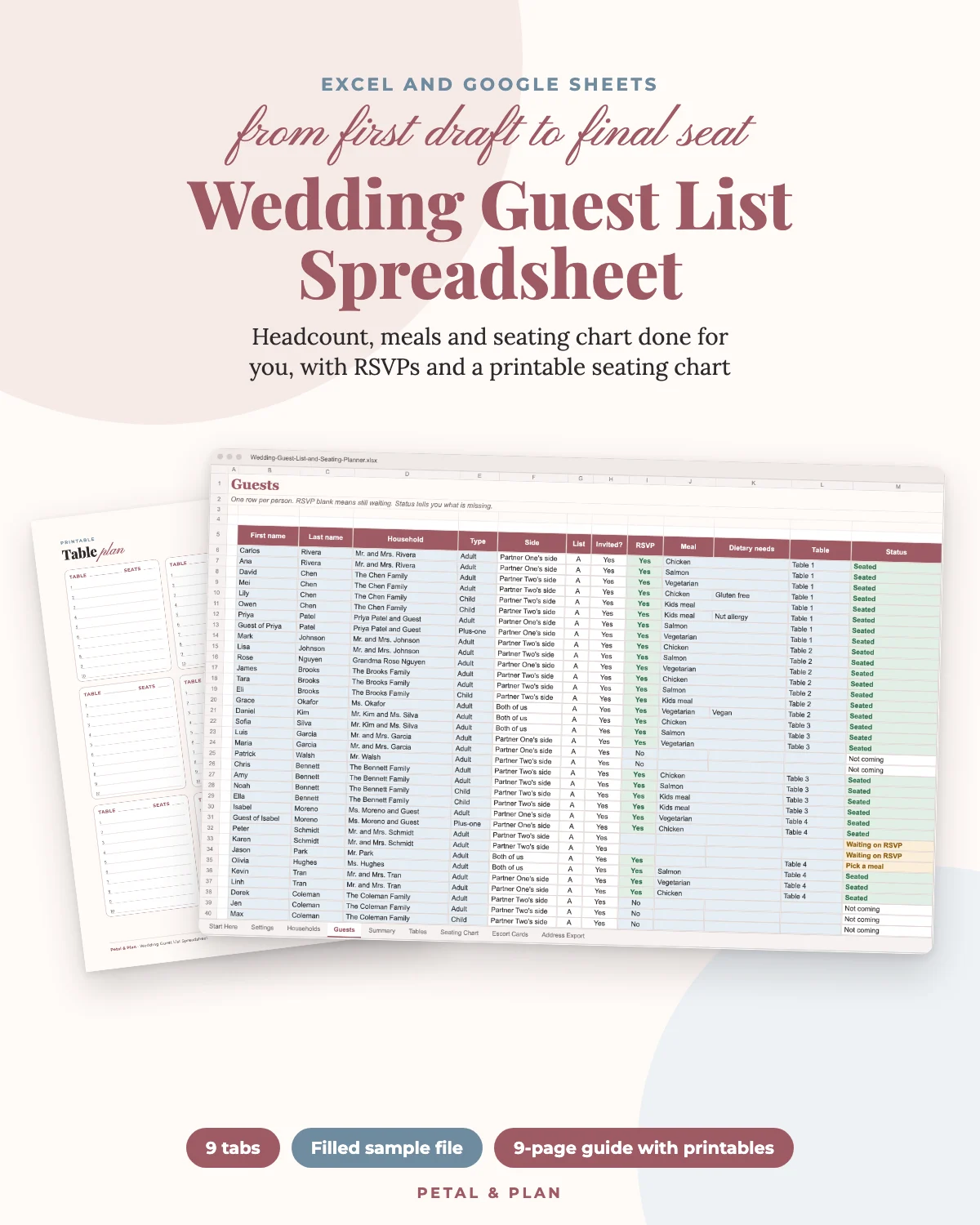
Want that done for you? The Wedding Guest List & Seating Planner is a $19 spreadsheet with an A and B list, a live headcount against your cap, RSVP and meal tracking, and a seating plan. Code PETAL20 takes 20 percent off.
Still building the budget behind the number? Our how to plan a wedding on a budget guide shows where the guest count fits in.
Frequently asked questions
How do I decide who to invite to my wedding?
Set the number first from your budget and venue, then write rules for plus-ones, kids and coworkers. Invite people either of you has talked to or met in the last year or two, and give each family a fixed share of seats.
Is it rude to not give guests a plus-one?
No, as long as the rule is the same for everyone. A common rule gives a joint invite to married, engaged and live-in couples, and not to single guests.
How much does each wedding guest cost?
It depends on your caterer and venue. Using The Knot 2026 average of about $80 a person for catering, plus example ranges for drinks, rentals and paper, one guest comes to roughly $113 to $165.
Is an A list and B list wedding rude?
Not if B-list guests get their invitation early enough to feel wanted. Send them at least 4 to 5 weeks before the RSVP date, and don't tell anyone which list they were on.
How do I tell family their kids aren't invited?
Address the invitation only to the adults, add a short adults-only note on your website, and tell close family in person. Keep it the same for everyone, except kids in the wedding party.

Save it for later
Pin this to your Guest List & Seating board so it's there when you need it.
Save to Pinterest